
Do Visual Schedules Help Toddlers? (How Picture and Chore Charts Work)
For some reason, the end of summer always feels like the beginning of something big. Perhaps it's because of all my years in public education, but August is like my New Year's Eve. I get more excited to break out the office supplies, order my favorite erasable pens (seriously, I should own stock in this company since I buy them in bulk; if you fear ink commitment like I do, you are going to want to check these* out) and crack open my new planner than I do about New Year's festivities. Yes, I'm an office supply dork.
So what does this have to do with toddlers? Well, I think all those back-to-school ads leave many parents looking for ways to streamline their days and routines. A smooth-running routine makes for happier parents and happier kids, so today I want to talk about one of my favorite tools: visual picture schedules and chore charts.
You may be thinking, "Charts and schedules for 2- and 3-year-olds?" Yup. As a longtime early childhood educator, I've seen the many benefits of using pictures with young children. They make transitions easier, cut down on power struggles and build independence.
Why Pictures Work for Young Kids
Let's start by looking at the development behind visual schedules. Using pictures with young children:
- Helps them understand what's coming next, which makes transitions easier. Let's be honest, young kids aren't great listeners. You can tell them until you're blue in the face that you will play outside AFTER dinner, but they just don't seem to get it! Seeing is believing for many young kids.
- Helps with predictability. Visual schedules set up a clear routine for the day. They help young children understand "first this, then that," an important idea that will come in handy when they go to school.
- Supports early literacy. Charts are read like a book, with pictures and a little text. "First this, then that" is also how stories work: first this happens, then that happens. Ta-da, you're working on comprehension.
- Teaches responsibility and planning. Visuals help little ones understand steps and sequences, which builds executive thinking skills. For example, a chart of the steps for using the bathroom helps a toddler or preschooler understand each step and how they fit together, with lots of repetition.
- Teaches independence and builds self-esteem. Our goal as parents is to grow independence in our children and give them tools for success along the way. Children who learn to do things on their own and finish tasks feel confident. Who doesn't want that for their kid?!
- Helps with language comprehension and listening. I often tell parents that 93% of communication is tone of voice and body language, and only 7% is our actual words! Pointing to pictures on a schedule helps build understanding, focus, attention and listening.
- Prepares them for daycare and preschool. If you've ever stepped into a preschool classroom, you have undoubtedly seen a visual picture schedule. The preschool teachers I worked with referred to theirs FREQUENTLY, and it made a huge difference in the flow of the day.
Why Some Kids Need Visuals Even More
It's equally important to understand our children's unique wiring (how they experience the world), because it can help us identify the best way to teach them.
- Anxious kids and kids who get "stuck." Not knowing what comes next can make some kids anxious. When I was the social work support for a special education preschool program, there was a 3-year-old on the autism spectrum who felt anxious when he arrived at school and wanted to go straight to the gym. A picture schedule helped him understand 1) that we WOULD be going to the gym and 2) what needed to happen first, like breakfast and free play. He would go check the schedule on the board often to see what was left before we went to his favorite place. Trying to explain it to him didn't help. Showing him the schedule calmed him right away.
- Kids who are easily overwhelmed by what they see. Young children learn best from images that are clean, crisp and uncluttered, with color pictures on a white background. Young children's brains can only process about five pieces of information at a time, and 20/20 vision usually isn't complete until 3 to 5 years of age. Too much color and imagery makes it hard to focus on what's important. LESS is MORE!
- Kids with a high need for control. A choice board gives them some control in a way that works for everyone, which can mean fewer power struggles.
Strategies: How to Use a Visual Schedule or Chore Chart
Here are some simple strategies you can use to bring visual schedules and chore charts into your daily routines:
- Keep it simple. There are LOTS of easy, crafty ways to make a visual schedule or chore chart. For you crafty moms, here's your excuse to head to the office supply store, yay! Just keep in mind that colorful charts with lots of words, stickers and images will be harder for your little one to understand. Keep the end goal in sight: practicality over looks.
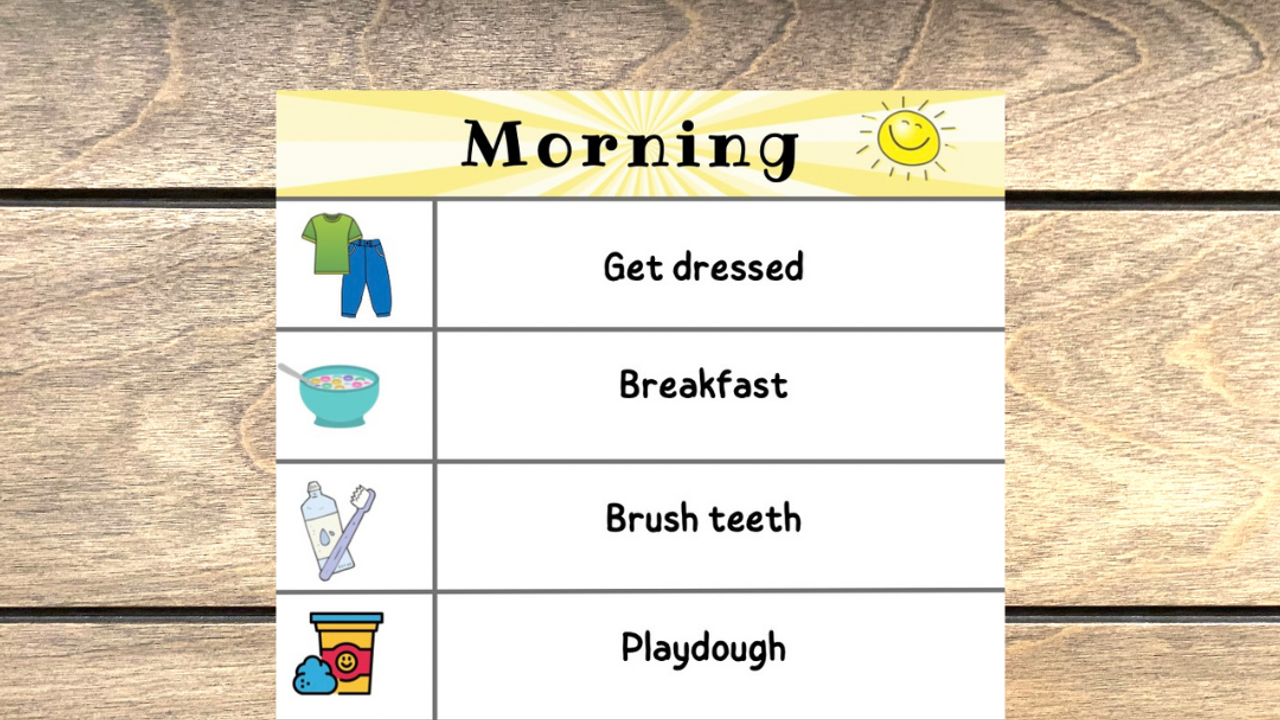
- Make a visual routine chart. Outline the whole day, or parts of it like morning, afternoon and bedtime. Swap activities in and out depending on the day. When I was looking for a routine chart for my kids back in the day, there were always one or two things on it that didn't fit our routine, so make yours fit your family.
- Add a chore chart as they grow. Simple chores build self-esteem and prepare kids for adulthood. I am a FIRM believer that children should have chores AND that they shouldn't get paid for them. Kids need to learn that sometimes there are things we need to do every day that we don't like, but they still need to be done. Start with simple tasks like making the bed or feeding the dog, and take advantage of the fact that young children LIKE to help (because that won't last long!). Imagine this: you start a chore chart with your preschooler. After several weeks, you only need to point him back to his chart. Several weeks later, he's doing his chores on autopilot. I know you don't believe me, but it is possible!
- Use a choice board. Giving young children choices can help reduce tantrums, meltdowns and power struggles. BONUS: it helps with language, too, because of all the repetition. As you plan your day, offer choices like "Do you want to go outside or do water play?" or "Do you want to play with your cars or your blocks?" Sharing control throughout the day builds self-esteem and confidence.
- Follow the prompting sequence. When working on listening with little ones, I always talk to parents about the prompting system: 1) Help me (a physical prompt), 2) Show me (a visual cue) and 3) Tell me (a verbal direction only). A lot of parents jump right to #3 and get frustrated when their tots "don't listen." Start where your child is, and use visuals to help. You can learn more about getting young children to listen in this YouTube video.
- Or grab a done-for-you system. If you just want something ready to go, you can purchase my visual system in my Etsy shop. Let me be upfront: it is not super jazzy looking, because less truly is more. It's designed to grow with your child and works as a routine chart, a chore chart and a choice system. It includes blank cards so you can add your own activities and chores, a tip sheet on how to use it, and because it's a PDF download, you can print it as many times as you need.
I go more in depth on this topic in my YouTube video. You can watch it here.
For more early childhood and parenting tips, be sure to sign up for my free weekly newsletter.
The Bottom Line
Visual schedules and chore charts help toddlers and preschoolers understand what's coming next, which makes transitions easier and builds listening, early literacy and independence. Kids who get anxious or stuck, are easily overwhelmed by what they see or need some control benefit even more, especially from simple, uncluttered pictures. Start with a simple routine chart, add chores and choices as your child grows, and use pictures to show before you tell. Your child and their future teachers will thank you for it!
Quick Answers
At what age can a toddler use a visual schedule? Even 2- and 3-year-olds can benefit from a simple picture schedule. Start with just a few clear pictures of familiar routines.
What should a toddler visual schedule look like? Keep it simple: one clear color picture per step on a white background, with very little text.
Should I pay my child for doing chores? I don't recommend it. Chores teach children that some things just need to be done every day, and young kids usually LOVE to help.
All my best, Jill
Jill Urbane, LCSW, is an early childhood interventionist with nearly three decades of experience working in the homes of families with young children.
*As an Amazon Associate, I earn from qualifying purchases.
Hey!


