
Why Won't My Toddler Share? (And How to Teach Turn-Taking)
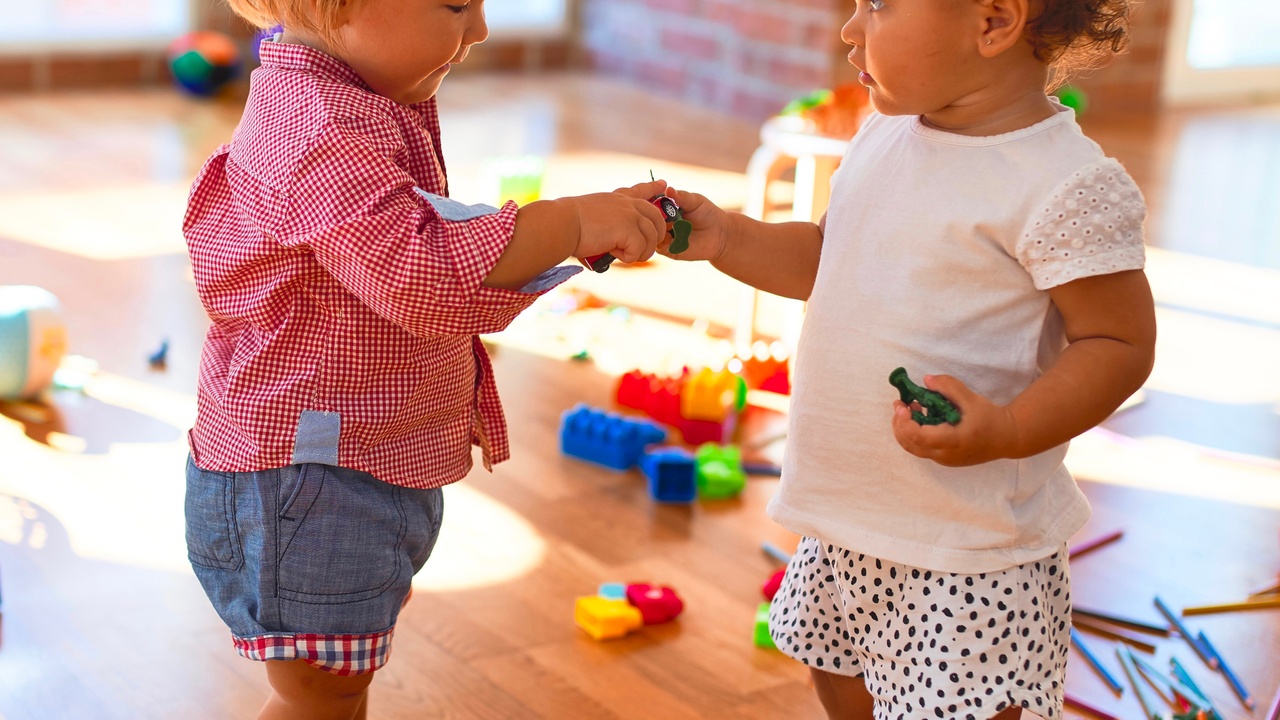
One of the most frequent questions I get from parents is, "How do I get my toddler to share?" I wish I had a quick and easy answer, but, alas, sharing is a complex concept for toddlers and preschoolers.
Why Toddlers Don't Share
Most toddlers won't share because their brains aren't ready yet. According to the American Academy of Pediatrics, children under three aren't able to understand sharing, and some early childhood experts estimate that sharing skills develop around 31⁄2 to 4 years of age (MacLaughlin, 2017).
A big factor is a social-emotional stage toddlers go through called egocentrism. They haven't yet developed the ability to understand other people's perspectives. When they take a toy from another child, they don't understand that their action made the other child angry or sad. That comes with time, practice, and feedback from loving, caring adults.
If you want to learn more about toddler social-emotional development, check out my YouTube video. Understanding what drives challenging toddler behavior makes it much easier to choose strategies that fit. In my experience, when we skip understanding our child's brain development, we expect far too much from them, and everyone ends up frustrated.
Why Some Kids Find It Harder
Not every toddler is ready for turn-taking at the same time. Some kids get frustrated quickly and either melt down or walk away from the activity. Follow your child's lead and take baby steps as they're ready. We don't want sharing to become a power struggle that turns them off from playing with others.
Some little ones also get overwhelmed when a playmate goes through all their things. Imagine, as an adult, if someone we barely knew came into our house and started going through our closets and touching our stuff. We'd be upset, and we have a lot more life experience and coping skills!
Siblings add another layer. There's often a history between them, and that takes time to change.
Strategies: How to Teach Turn-Taking
Use the word "turn" instead of "share." Think about it: when we share a cookie, we never get it back. How confusing for a young child! You want me to share my toys? Um, that would be a hard no. The best place to teach turns is during play with you.
- Start with one toy, like a car. Take the car, say "my turn," roll it a few times, then hand it over: "your turn." Let them play for a bit, then say "my turn" and take it back. This is where they get ticked, because they don't understand what's happening yet. Keep your turn super short, 2–3 seconds, then hand it back: "your turn!"
- Give them enough time with the toy. If you take it back too quickly, they'll get frustrated and either melt down or walk away.
- Try crayons. Toddlers love to have ALL the crayons. Start with one crayon for them and one for you. When they reach for yours, say, "Oh, you want a turn with my crayon? Then I'll take a turn with yours," and swap. They're usually surprised and will keep trying. Just keep repeating. They'll get it eventually.
- Model how to ask. When they grab for the toy, show them what to do instead, like holding out a hand. I like to take the toddler's hand, touch it to their chest, and say "me?" then hand them the toy quickly. Over time, you can make your turn a little longer: "Mommy's not done with her turn yet." That teaches them that asking doesn't always mean getting it right away.
- Trust your parent gut. If your child isn't ready for swapping yet, start by simply modeling the words and actions you want them to copy, like saying "me?" while touching your chest or holding out your hand.
Tips for playdates and siblings
Once you've practiced at home, you're ready to bring turn-taking into play with siblings and friends.
- Be a moderator. Stay close and watch, stepping in as needed to model what you practiced, for all the kids. Only step in when needed; give them a chance to work it out.
- Get older siblings on board. I always ask older sibs if they'd like to be a teacher for their younger brother or sister. They almost always say yes! Helping them understand why it matters and how to do it can really speed things up.
- Plan playdate toys ahead of time. Pick some toys for both kids to use in an area outside your child's bedroom. Planning ahead can avoid a lot of unnecessary stress.
- Give older kids a protected space. When my son was three, he loved building Lego towers in the living room. Our daughter was just learning to walk and always interfered with his play, much to his disgust. We told him he could build at the table or in his room, and that the living room was a family zone where play was open to everyone. That did the trick. Sometimes he stayed and let his sister join (begrudgingly), and other times he took his project to the kitchen table.
- When your child grabs a toy and another child cries, try: "We don't take toys from other kids because it makes them sad. We need to give it back," while helping your child hand it back. If your child is calm, you can coach them: "Would you like to ask him for a turn?" If the other child isn't ready, redirect: "I guess he's not done with it. Let's go find another toy."
Do you see how practicing at home first makes even these moments easier? Repetition is the key to learning for young children. The more you practice, the stronger the neural pathways you're building.
The Bottom Line
To review as we wrap this up, most toddlers don't share because their brains aren't ready yet. Children under three aren't able to understand sharing, and seeing things from someone else's point of view takes time to develop. Some kids also get frustrated or overwhelmed more easily, so follow your child's lead and take baby steps. Using the word "turn" instead of "share," practicing short, playful turns with you at home first, and then bringing those skills into playdates and sibling play will help lay the foundation for sharing that will help your child as they grow.
Quick answers
At what age should a toddler be able to share? According to the American Academy of Pediatrics, children under three aren't able to understand sharing. Some experts estimate sharing skills develop around 31⁄2 to 4.
Should I make my toddler share? Forcing it usually leads to frustration. Teach turn-taking instead, starting with short, playful turns with you.
What do I do when my toddler grabs toys from other kids? Calmly help them give the toy back, explain that it makes the other child sad, and coach them to ask for a turn.
If toy battles are turning into daily tantrums, grab my free Tantrum Tamer Guide for simple ways to avoid power struggles before they start.
Jill Urbane, LCSW, is an early childhood interventionist with nearly three decades of experience working in the homes of families with young children.
Hey!


